

[show]
[ hide ]
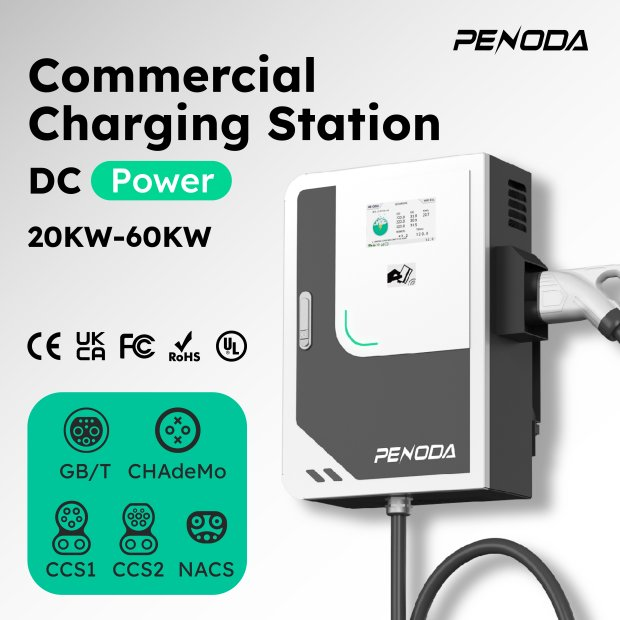
Penoda PDA 20 to 40 kW Home DC Fast Charger
Why higher power home DC charging can shorten daily charging time
Website article and product guide Prepared for Penoda September 2026
The Penoda PDA 20 to 40 kW home DC fast charger is a commercial-grade charging option for private residences with sufficient electrical capacity. Because it supplies DC power to the vehicle battery, it can avoid the power limit of the vehicle's onboard AC charger and reduce the time required for a substantial recharge. The best fit is a high-capacity private garage, a multi-EV household, or a residence where vehicles must return to service sooner than overnight AC charging allows.
The main constraint is the site, not the charger. A 20 to 40 kW DC charger requires a professional load assessment, a suitable three-phase supply, compatible protection equipment, an EV that accepts DC charging at the selected power, and installation that complies with local rules. For homes with low daily mileage or limited grid capacity, a 7 to 11 kW AC wallbox may remain the better choice.
Huawei Digital Power explains that an EV battery stores direct current. With AC charging, the vehicle's onboard charger converts alternating current from the grid into DC before the battery can store it. The onboard charger therefore helps determine the maximum AC charging rate.
A DC fast charger performs the conversion outside the vehicle and sends controlled DC power to the battery through the vehicle's charging system. This arrangement can deliver more power than the vehicle's onboard AC charger accepts, provided the vehicle and the home electrical system support the requested rate.
• Shorter charging windows. A higher power DC charger can restore useful energy between trips instead of relying on a full overnight session.
• Less dependence on the onboard AC charger. The PDA supplies DC power, so it is not capped by a vehicle's 7 kW or 11 kW AC onboard charger in the same way as an AC wallbox.
• Flexible placement. Penoda lists wall-mounted and pedestal installation for a private garage, driveway or sheltered parking area after a site assessment.
• Controlled power use. Dynamic load management can coordinate charger demand with available electrical capacity when the site is designed with suitable limits and protection.
For a 60 kWh battery, charging from 10 percent to 80 percent requires 42 kWh. Ideal time equals energy divided by charger power and excludes losses, conditioning and charging taper.
Power | Charging type | Ideal 10 to 80 percent time | Planning note |
7 kW AC | Typical home AC | About 6.0 hours | Limited by AC supply and onboard charger |
11 kW AC | Higher power home AC | About 3.8 hours | Requires a vehicle and site that support 11 kW AC |
20 kW DC | Penoda PDA option | About 2.1 hours | Balanced option for high-capacity residential sites |
30 kW DC | Penoda PDA option | About 1.4 hours | Faster turnaround with greater site demand |
40 kW DC | Penoda PDA option | About 1.1 hours | Fastest option in this 20 to 40 kW comparison |
Actual charging time will usually be longer. The vehicle's battery-management system controls the accepted power, and many EVs reduce charging power as the battery approaches a high state of charge. Battery temperature, initial state of charge, vehicle DC limit, cable and charger conditions, and site power limits also affect the result.
The 20 kW model offers the lowest electrical demand within the focused range. The 30 kW version shortens turnaround further, while the 40 kW version provides the highest charging rate discussed in this guide. The correct choice should follow the home's spare electrical capacity and the EV's sustained DC charging capability.
Penoda publishes a compact enclosure size of 650 by 450 by 150 mm and a weight of 65 kg for this PDA product page. Wall mounting can preserve floor space, while a pedestal can support parking layouts where a suitable wall is unavailable. Structural support, cable reach, vehicle position and weather exposure must be checked before installation.
The published PDA functions include App-based starting, RFID, Plug and Charge, Wi-Fi, 4G and Ethernet connectivity. OCPP 1.6 JSON support allows integration with a compatible backend. These features can help a household monitor charging or control access when the charger serves more than one driver.
Penoda lists an IP55 enclosure and IK10 impact protection, plus under-voltage, over-voltage, over-current, relay-stuck and over-temperature protection. The published operating range is minus 30 degrees Celsius to 55 degrees Celsius, with intelligent derating in extreme heat. Local electrical design and installation rules remain mandatory.
Item | Published information |
Rated power options | 20 kW 30 kW 40 kW within this article's scope |
Published input | 230 or 400 VAC plus or minus 20 percent 50 or 60 Hz |
Installation | Wall mounted or pedestal floor mount |
Published connector | IEC 62196 CCS2 on the detailed specification section |
Access | RFID App start Plug and Charge |
Connectivity | Wi-Fi 4G Ethernet |
Backend | OCPP 1.6 JSON |
Load control | Dynamic load management through the App |
Enclosure | IP55 weather protection and IK10 impact resistance |
Dimensions and weight | 650 by 450 by 150 mm 65 kg |
Product options can vary by order and market. Confirm the exact connector, certification, input configuration, software functions and installation accessories in the final technical specification before purchase.
• A private residence with adequate three-phase electrical capacity and a dedicated parking area
• A multi-EV household that needs more than overnight charging
• A home used by a high-mileage driver who returns between trips
• A premium residence, villa or residential compound that requires controlled access
• A combined home and small-business property where the same charger serves approved vehicles
A PDA home DC fast charger is not necessary for every driver. A 7 to 11 kW AC wallbox is often sufficient when the vehicle remains parked overnight, daily mileage is moderate, the home has limited spare capacity, or installation cost is the main priority. DC charging becomes more valuable when turnaround time has a clear operational or lifestyle benefit.
• Ask a qualified electrician or electrical engineer to calculate the home's existing and future peak demand.
• Verify that the utility service, transformer, switchboard, protection devices, cable route and earthing system can support the selected output.
• Confirm the EV's connector and maximum DC charging rate. A 40 kW charger cannot force a vehicle to accept 40 kW.
• Select an installation position with safe cable reach, vehicle clearance, drainage, ventilation and protection from impact.
• Configure load management so charging demand remains within the approved site limit.
• Complete local permits, inspection and commissioning before regular use.
PDA option | Best considered for | Check before selection |
20 kW | Homes seeking a clear step up from AC charging with lower site demand | Available capacity vehicle limit typical dwell time |
30 kW | Multi-EV homes or drivers who need shorter charging windows | Higher supply demand and sustained vehicle acceptance |
40 kW | High-capacity residences that prioritize the fastest option in this range | Grid approval cable and protection sizing vehicle charging curve |
Yes, but only where the residence has sufficient electrical capacity and local rules allow the installation. This is a high-power residential solution, not a direct replacement for every domestic AC wallbox.
AC charging relies on the vehicle's onboard charger to convert AC into DC. A DC charger performs that conversion outside the vehicle and supplies controlled DC power to the battery, allowing a higher rate when the vehicle and site support it.
No. The vehicle requests the power it can accept. Battery temperature, state of charge, the charging curve, site limits and load-management settings may reduce the actual rate.
The Penoda PDA 20 to 40 kW home DC fast charger gives suitable private residences a faster alternative to conventional AC charging. Its main advantage is shorter turnaround: the charger supplies DC power to the battery and can operate above common onboard AC charger limits. Flexible installation, dynamic load management and connected access functions make the platform relevant to high-capacity homes and multi-EV households.
The decision should begin with a site and vehicle assessment. Once electrical capacity, DC compatibility and local requirements are confirmed, Penoda can match the project to a 20, 30 or 40 kW configuration.
Plan a home DC charging project with Penoda Contact Penoda with the destination country, EV model, available electrical capacity, preferred power and installation location.
Huawei Digital Power What Is EV Charging A Complete Guide to How It Works Accessed September 16 2026.
Penoda PDA Series 20 to 60 kW Commercial DC Fast EV Charger Accessed September 16 2026.
Editorial note Charging times are theoretical calculations, not product performance guarantees. Confirm the final charger specification and local installation requirements before publication or purchase.
Have Questions Or Want To Partner With Us?
Reach Out.
Company Address: MAX Technology Park, Chengyang District, Qingdao, Shandong, China


