

[show]
[ hide ]
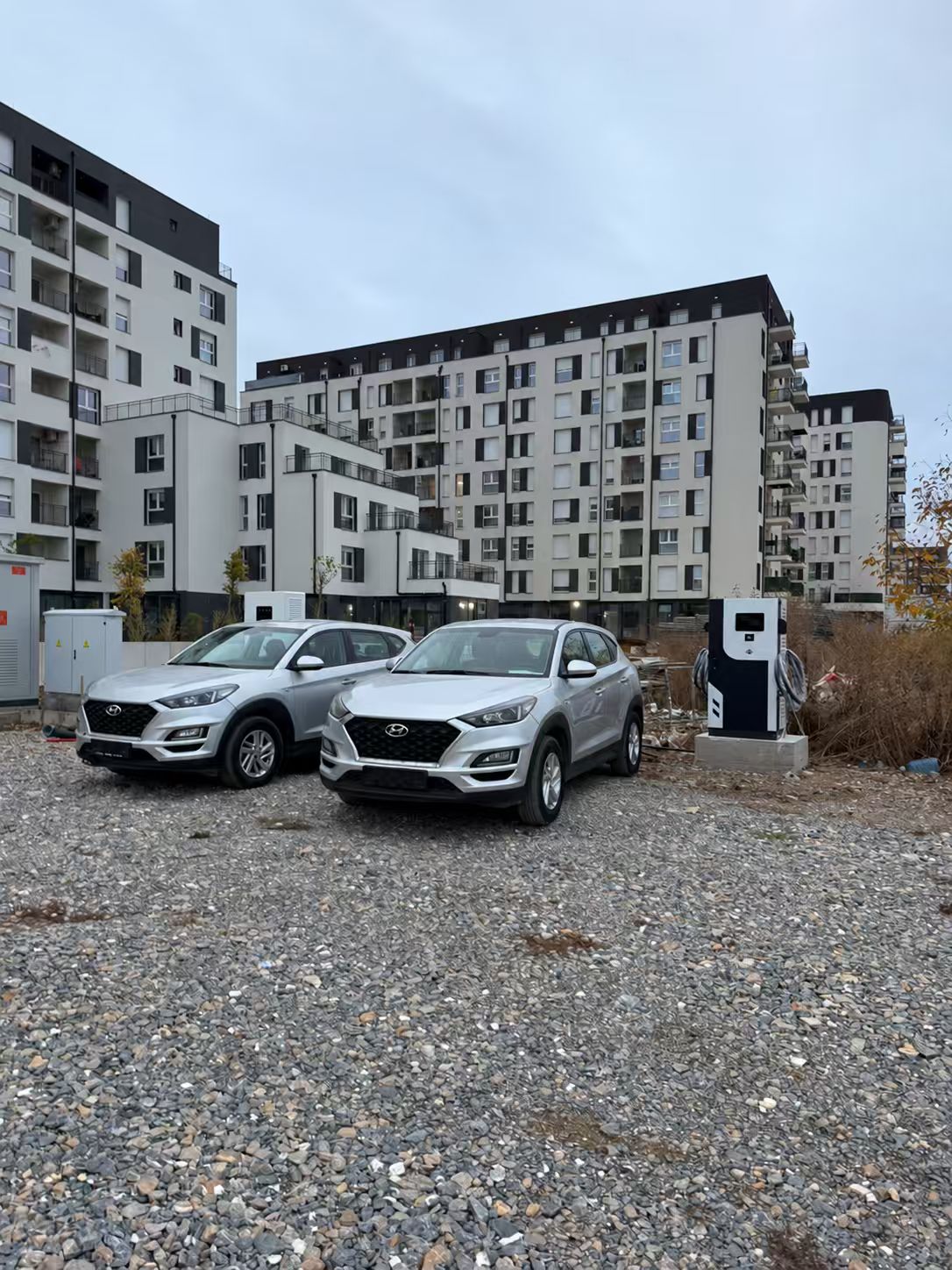
PENODA’s 120kW EV charger in Kosovo is installed beside an apartment development, bringing a commercial DC charging unit into a property-based parking setting. The site photograph shows the floor-mounted cabinet on a concrete foundation, with charging cables stored along its sides and two vehicles parked nearby.
For distributors, property developers and charging operators considering a 120kW EV charger in Kosovo, the installation highlights more than equipment capacity. Vehicle access, cable reach, electrical supply and the operating model all influence the usefulness of a commercial EV charging station. This case examines the visible installation alongside the PENODA PDB product range and the decisions buyers should address when planning a comparable project.
The project location and 120 kW rating were supplied with the installation photograph. The image shows the main charging cabinet mounted on a rectangular concrete base in an outdoor area near multi-storey apartment buildings.
The surrounding parking surface is gravel, and the area around the equipment appears unfinished. A front-facing display and cable loops on both sides of the cabinet are visible. The two nearby vehicles are parked; the photograph does not show them connected to the charger.
Project element | Available information |
Location | Kosovo |
Charger rating | 120 kW, as confirmed in the supplied project details |
Product reference | PENODA PDB commercial DC charging range |
Installation type | Floor-mounted cabinet on a concrete foundation |
Visible setting | Outdoor parking area beside apartment buildings |
Documentation | Project installation photograph |
The image documents the physical installation. It does not establish the commissioning date, public access arrangements or completed charging sessions. Those details require the project handover and operating records.
An apartment development creates several possible charging needs. Residents may require overnight charging, visitors may need a top-up during a shorter stay, and commercial vehicles may have limited time between journeys. These are different services, even when they share the same parking area.
The International Energy Agency’s analysis of electric vehicle charging explains how housing patterns and access to home charging influence demand for shared and public infrastructure. It provides useful context for property-based charging, rather than a measure of demand at this specific Kosovo site.
A 120kW EV charger in Kosovo can therefore be evaluated as one part of a property's charging plan. The choice should follow the expected users, their vehicle capabilities and their parking duration. Where cars remain parked overnight, lower-power AC charging may also deserve consideration. Where drivers need to add energy during shorter visits, DC charging addresses a different requirement.
The photograph alone does not identify the intended customer group. For a comparable development, defining that group early helps the owner determine access rules, parking arrangements and an appropriate commercial model.
The PENODA PDB commercial DC charging station is the product reference for this case. Its published range includes a 120 kW option alongside other output configurations.
The product page lists OCPP 1.6J communication, 4G/Wi-Fi/Ethernet connectivity, a touchscreen interface and configurable connector standards. It also describes floor mounting and IP55/IK10 enclosure ratings.
These are product-range specifications. The precise connector selection, firmware, network arrangement and enabled functions for the photographed station should be checked against its order documents.
When comparing a 120kW DC fast charger with other equipment, buyers should establish what the stated rating represents. A station’s total available output and the output available through an individual connector are different procurement questions.
Cable loops on two sides of a cabinet do not prove that each outlet can deliver the full station rating at the same time. For multiple-outlet operation, the quotation should explain simultaneous charging capability, allocation rules and the limits that apply under different vehicle conditions.
This distinction matters when estimating bay turnover or serving vehicles with different power requirements. It should be resolved before the equipment configuration is approved.
Power is expressed in kilowatts; the energy delivered during a visit is measured in kilowatt-hours. A useful planning relationship is:
Delivered energy ≈ average charging power × charging duration.
For example, maintaining an average output of 60 kW for 20 minutes would deliver approximately 20 kWh at the charger output. This is an illustrative calculation, not a measured result from this project. Energy stored in the battery may be lower because of losses.
A vehicle may also request less than the station’s rated output because of its battery state of charge, temperature, charging curve or electrical limits. A 120kW EV charger in Kosovo should therefore be assessed against the vehicles expected to use it, rather than a promise of identical charging times for every driver.
The cabinet’s relationship to the buildings, parking surface and nearby vehicles makes this case useful for installation planning. The surrounding space is as important as the equipment footprint.
The visible concrete base provides a defined mounting position for the cabinet. The photograph does not reveal its structural design, cable entry arrangement or electrical connections.
For a similar project, foundation design and finished ground levels should be coordinated with the equipment drawings and site conditions. The installation team also needs to account for drainage, maintenance access and the transition between the foundation and the parking surface.
Because the photographed surroundings appear unfinished, the image is best understood as an installation-stage record. It should not be used on its own to demonstrate that final surfacing, signage and customer access arrangements have been completed.
The cables are stored beside the cabinet rather than shown connected to a vehicle. This makes cable reach an important item for the final layout review.
Charging ports vary in position between vehicle models. The intended parking direction, bay dimensions and distance from the cabinet should allow users to connect without pulling a cable tight or obstructing an adjacent space.
Clear bay markings and a practical connector storage position can help drivers understand how to use the station. These details should be considered when the surrounding parking works are finalized.
A 120kW EV charger in Kosovo needs a layout that accommodates more than vehicle parking. Users need to reach the screen and handle the connector; maintenance staff need access to the cabinet according to the service requirements.
The owner should also decide how charging spaces will be identified and managed. A charger can be physically accessible while its intended bay is occupied by a vehicle that is not charging. Parking policy and clear instructions are therefore part of the service design.
The presence of vehicles beside a station does not establish charging compatibility. Buyers should check the actual models intended to use the equipment, including their connector interfaces, supported voltage range and DC charging limits.
The PDB page lists configurable connector options. The selected connector must be confirmed for the delivered unit; a product family offering several standards does not mean every unit includes all of them.
For property-based charging, access rules are equally important. A resident-only service may require controlled access, while a service available to visitors needs a clear way to start a session and obtain assistance.
These decisions affect instructions, payment arrangements and support responsibilities. They should be included in the operating brief rather than left to individual drivers to work out after installation.
For operators evaluating a 120kW EV charger in Kosovo, connectivity should be considered alongside the physical installation. Useful management information includes equipment status, session records and fault information, subject to the configured hardware and backend.
The Open Charge Alliance’s OCPP overview explains the protocol used for communication between charging stations and management systems. The exact protocol version and implemented functions should be agreed between the equipment supplier and the selected platform.
PENODA’s charging station management system provides an internal reference for discussions about monitoring, access control and commercial operation. Its availability does not establish which platform or functions are active at this installation.
The operating plan should describe how a driver identifies the station, receives authorization, starts charging, checks progress and ends the session. If the service is paid, pricing and payment instructions should be clear before charging begins.
Authorization and payment are separate functions. An RFID card may identify an approved user without processing a bank-card payment. Similarly, app access does not automatically confirm support for a particular payment provider or local billing arrangement.
Before a comparable site enters regular service, the parties should agree on the evidence required for acceptance. This can include representative vehicle tests, agreed backend functions, session records and a documented support process.
Such records provide a stronger basis for confirming readiness than a photograph of installed equipment alone. They also give the operator a reference when investigating future service issues.
The electrical assessment for a 120kW EV charger in Kosovo should consider the building’s existing demand as well as charging requirements. The output rating should not be treated as a complete specification for the upstream supply.
The electrical contractor needs the confirmed equipment documentation and site information to assess the supply arrangement, distribution equipment, protection, earthing and cable route. A project may also need coordination with the relevant network operator.
Where more chargers are planned, the owner should define the expected future demand and how charging power will be managed. Provision for future cable routes and equipment positions can help avoid repeated disruption to completed parking works.
After commissioning, operators can evaluate service quality using successful session starts, energy delivered, availability and support requests. Business assessment should include electricity costs, network charges where applicable, software, payment processing and maintenance.
This case does not include utilization or revenue figures. Those results should come from operating records before being presented as evidence of commercial performance.
The supplied project information identifies Kosovo and a 120 kW charger. The photograph shows a floor-mounted cabinet on a concrete foundation beside apartment buildings. Commissioning and operating results have not been supplied.
No. Actual charging time depends on the energy required, vehicle charging capability, battery conditions and available power during the session. Charging-time estimates should use the intended vehicle models and operating conditions.
That capability should not be assumed. Buyers must confirm the station’s total output, per-connector limits and simultaneous charging configuration in the technical offer.
Provide the location, site layout, electrical supply details, expected vehicles and intended user group. Add quantity, connector requirements, backend preferences and payment or branding needs where applicable.
Qingdao Penoda Electrical Co., Ltd. develops and manufactures EV charging equipment and offers OEM/ODM services for customers requiring customized charging solutions. Its commercial range supports discussions with distributors, installation partners, property developers and charging operators.
Planning a 120kW EV charger in Kosovo or a comparable project elsewhere?
Contact PENODA for a technical proposal and quotation. Share your site photographs, available electrical supply, expected vehicle models and required quantity, together with any connector, backend or customization requirements. These details help define a charging configuration suited to the property and its intended users.
Have Questions Or Want To Partner With Us?
Reach Out.
Company Address: MAX Technology Park, Chengyang District, Qingdao, Shandong, China


