

[show]
[ hide ]
As Europe’s largest electric vehicle (EV) market, Germany offers immense opportunities for commercial charging network operators. However, entering this premium market requires overcoming some of the world's most stringent technical barriers: the European MID (Measuring Instruments Directive), Germany’s local Eichrecht (Calibration Law), and the technical prerequisites for government funding.
Recently, Penoda—a leading source factory with over a decade of R&D and manufacturing expertise in intelligent EV charging solutions—successfully empowered a commercial real estate developer in Baden-Württemberg, Germany, to deploy a high-ROI commercial fast-charging network.
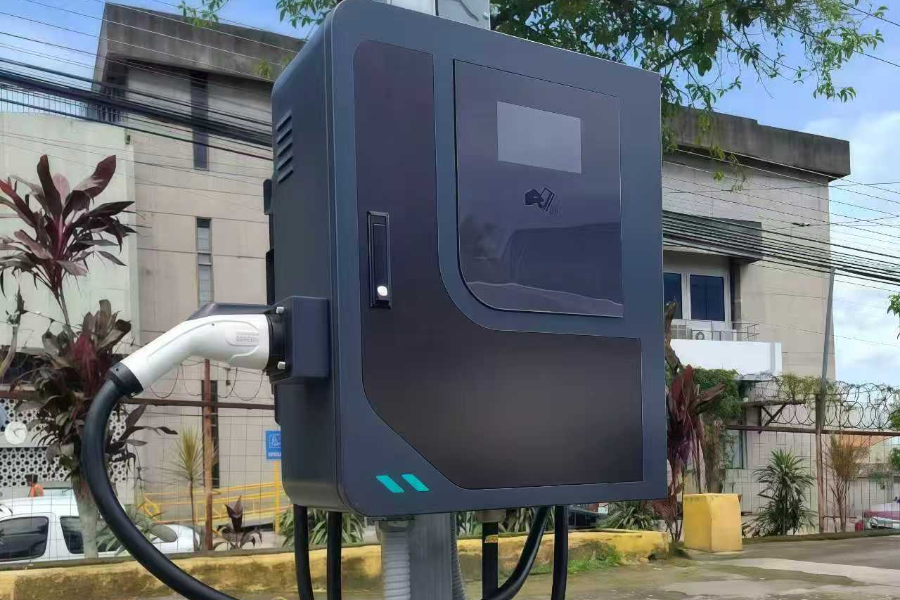
By choosing the Penoda PDA Series 40kW CCS2 DC Fast Charger, the client successfully bypassed grid capacity limitations, achieved 100% regulatory compliance, and unlocked substantial German federal subsidies for 2026.
The client aimed to install a fleet of DC fast chargers in a premium mixed-use commercial parking lot. However, their project stalled during the planning phase due to three major roadblocks:
The Eichrecht Calibration Trap: German law mandates that any EV charger used for public or commercial billing must not only use an MID-certified meter but also comply with Eichrecht. This requires all charging data to be encrypted, transparent, and tamper-proof for the end consumer. Non-compliance results in severe fines.
Prohibitive Grid Upgrade Costs: The commercial park’s existing low-voltage grid could not support multiple DC chargers running at full capacity simultaneously. Upgrading to a medium-voltage grid required high capital expenditure and lengthy approval times from the local utility (Verteilnetzbetreiber).
Strict Hardware Requirements for 2026 Subsidies: To qualify for Germany’s lucrative 2026 commercial EV infrastructure subsidies and tax write-offs, the hardware had to feature intelligent communication (OCPP) and advanced load management.
Leveraging our deep experience in European B2B market compliance, Penoda provided an integrated hardware and software solution centered around our flagship PDA Series 40kW CCS2 Commercial DC Fast Charger.
The PDA 40kW charger was engineered from day one to meet the highest European metrological standards:
Built-in MID-Certified DC Meter: Ensures billing accuracy with negligible error margins, satisfying basic EU regulations.
Integrated Eichrecht-Compliant Data Signing: The charger integrates a specialized cryptographic signing module compatible with OCPP 1.6J and OCPP 2.0.1. When a driver pays via RFID or QR code, the charger generates an encrypted, digitally signed receipt. Users can verify their exact energy consumption transparently, ensuring 100% legal compliance for commercial operation in Germany.
To eliminate the need for costly grid expansions, we activated Penoda’s advanced Dynamic Load Balancing (DLB) system:
The chargers continuously monitor the real-time power consumption of the commercial building.
During peak hours or when multiple EVs plug in simultaneously, the DLB system automatically and intelligently scales down the output of individual 40kW stations. This prevents grid overloads while fulfilling the German government's mandate for "grid-friendly" smart charging hardware.
As an authentic source manufacturer, Penoda guarantees premium build quality and long-term stability:
The entire PDA series carries certified CE, IEC, and RoHS marks, ensuring top-tier electrical safety and electromagnetic compatibility (EMC).
Manufactured under strict ISO 9001, ISO 14001, and ISO 45001 management systems, our chargers offer the high reliability that meticulous German operators demand, significantly lowering long-term operational and maintenance (O&M) costs.
Thanks to the compliant design and smart grid capabilities of the Penoda PDA 40kW DC charger, the client successfully capitalized on Germany’s latest 2026 financial incentives:
Baden-Württemberg Regional DC Subsidies: The project secured local infrastructure subsidies covering up to 50% of the hardware and installation costs.
2026 Special Tax Depreciation (Sonderabschreibung): Capitalizing on Germany’s extended tax incentives for commercial EV infrastructure running through 2027, the client claimed a 40% special depreciation write-off in the very first year of investment, significantly optimizing corporate cash flow and accelerating their ROI.
In a market as regulated as Germany, a commercial EV charger is more than just a piece of hardware—it is a vital financial asset that must secure subsidies and protect the operator from legal risks. The Penoda PDA 40kW CCS2 DC Fast Charger proves that by combining MID/Eichrecht billing compliance, smart DLB scheduling, and robust CE/IEC/ISO safety standards, B2B buyers can confidently scale their networks across Europe.
Written by Austin, EV Charging Solutions Expert at Penoda Power
Ready to Deploy Compliant EV Charging Stations in Germany?
Don't let regulatory hurdles delay your project. Contact Penoda’s engineering team today to get a tailored quote for MID/Eichrecht-ready 40kW, 60kW, or 120kW DC hardware and ensure your eligibility for 2026 subsidies.
Get a Compliant Hardware Quote Now
Have Questions Or Want To Partner With Us?
Reach Out.
Company Address: MAX Technology Park, Chengyang District, Qingdao, Shandong, China


